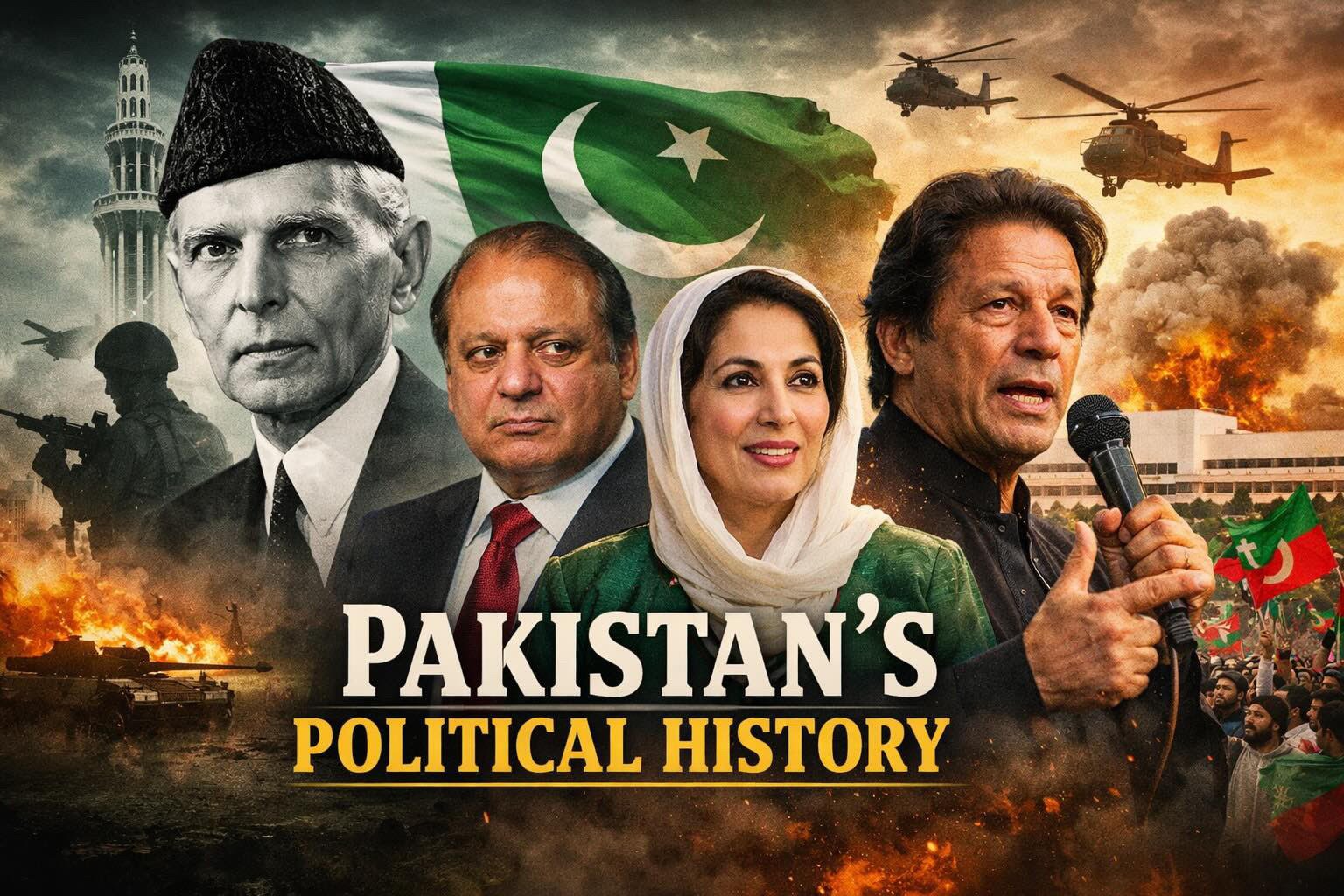
Pakistan’s political history is marked by contradiction. Created in the name of constitutional rights and political
representation, the country has spent much of its existence negotiating the boundaries between democratic rule and
institutional control. While elections have been held regularly, real power has often rested outside parliament —
most notably with the military establishment.
From Muhammad Ali Jinnah’s democratic vision to repeated military interventions, from political dynasties to
populist movements, Pakistan’s political evolution reflects a continuous struggle over authority, legitimacy, and
national identity. This struggle has been shaped not only by internal weaknesses but also by Pakistan’s strategic
importance in global geopolitics.
Muhammad Ali Jinnah and the Founding Vision
Muhammad Ali Jinnah, Pakistan’s founder, was not a religious ideologue but a constitutional lawyer deeply
committed to parliamentary democracy. His demand for Pakistan stemmed from fears of Muslim political
marginalisation in a united India, not from a desire to establish a theocratic state.
Jinnah’s political philosophy emphasised:
Rule of law
Equal citizenship
Minority protection
Civilian supremacy
In his landmark speech on 11 August 1947, Jinnah stated that religion was a personal matter and had “nothing to do
with the business of the state.” This speech remains one of the most significant — and contested — references in
Pakistan’s ideological debate.However, Jinnah’s death in 1948 deprived the new country of its only unifying civilian
authority. Pakistan inherited weak political institutions, an underdeveloped party system, and leaders with limited
administrative experience. This absence of continuity proved decisive in shaping future power dynamics.
Early Political Instability and Institutional Imbalance
Between 1947 and 1958, Pakistan experienced severe political instability. Governments changed frequently,
constitution-making was delayed, and disputes between the centre and provinces deepened. Pakistan adopted its first
constitution only in 1956, nearly a decade after independence.
While civilian politics faltered, two institutions remained strong and cohesive:
The civil bureaucracy
The military
Both inherited organisational discipline from British colonial rule. As political instability intensified, these
institutions increasingly viewed themselves as guardians of national stability rather than subordinate state
organs.This imbalance culminated in 1958, when General Ayub Khan imposed Pakistan’s first martial law, ending
parliamentary democracy and establishing a precedent for military intervention in politics.
The Military as a Permanent Political Actor
Unlike many armed forces worldwide, Pakistan’s military evolved into a central political institution. Several factors
contributed to this transformation:
Ongoing conflict with India, particularly over Kashmir
Early wars in 1948 and 1965
Cold War alliances that prioritised security over democracy
Military rule under Ayub Khan (1958–1969) introduced economic modernisation and controlled political
participation. While growth occurred, political dissent increased, particularly in East Pakistan, where economic and
political marginalisation eventually led to the 1971 civil war and the creation of Bangladesh.
The loss of East Pakistan was a national trauma that reinforced the military’s belief that civilian politics posed
existential risks. Subsequent military regimes under General Zia-ul-Haq (1977–1988) and General Pervez
Musharraf (1999–2008) further institutionalised military influence over governance, the judiciary, media, and
foreign policy.
The Bhutto Family: Populism, Power, and Tragedy
Zulfikar Ali Bhutto
Emerging after the 1971 crisis, Zulfikar Ali Bhutto founded the Pakistan Peoples Party (PPP) and mobilised the
working class through the slogan “Roti, Kapra aur Makaan.” His government introduced the 1973 Constitution,
nationalised key industries, and attempted to assert civilian supremacy.
However, Bhutto’s authoritarian tendencies, political repression, and electoral controversies weakened democratic
norms. In 1977, General Zia-ul-Haq overthrew his government. Bhutto was executed in 1979 after a widely
criticised trial, a moment many consider judicial murder.
Benazir Bhutto
Benazir Bhutto became the first female prime minister of a Muslim-majority country and a global symbol of
democratic resistance. Despite electoral victories, her governments were repeatedly dismissed amid allegations of
corruption and institutional interference. Her assassination in 2007 marked one of Pakistan’s darkest political
moments and exposed the fragility of its democratic process.
The Sharif Family: Developmental Politics and Institutional Conflict
The Sharif family, led by Nawaz Sharif, represented a business-oriented and conservative political tradition. Nawaz
Sharif served three terms as prime minister, focusing on:
Economic liberalisation
Infrastructure development
His decision to conduct nuclear tests in 1998 elevated Pakistan’s global standing but intensified tensions with the
military. In 1999, he was overthrown in a coup led by General Musharraf.
Despite repeated electoral success, the Sharif family’s reliance on compromise with powerful institutions
highlighted the conditional nature of civilian authority in Pakistan.
Imran Khan and Pakistan Tehreek-e-Insaf: Reform, Popular Support, and Structural Limits
Imran Khan’s rise marked a significant shift in Pakistan’s political landscape. Unlike the Bhutto and Sharif families,
Khan emerged outside traditional dynastic politics, appealing to voters frustrated with corruption, elite dominance,
and weak governance. Pakistan Tehreek-e-Insaf (PTI), founded in 1996, gained momentum in the 2010s, driven
largely by youth engagement, urban middle-class support, and overseas Pakistanis.
As Prime Minister from 2018 to 2022, Khan’s government focused on welfare initiatives such as the Ehsaas
Programme, health insurance expansion, and efforts toward tax reform and accountability. In foreign policy, he
pursued a more independent stance, seeking balanced relations with major powers while highlighting issues
affecting the Muslim world.
PTI governed within Pakistan’s long-standing structural constraints. Economic pressures, coalition politics, and
institutional resistance limited the scope of reform — challenges faced by previous civilian governments as well.
Khan’s removal through a parliamentary no-confidence vote in 2022 triggered widespread public mobilisation,
reflecting not only personal support for Khan but also broader frustration with Pakistan’s political system.
Subsequent legal cases and political restrictions against PTI intensified debates about political fairness, civil
liberties, and the boundaries of democratic participation in Pakistan.
Democracy or Managed Politics?
Pakistan’s political dilemma is not simply about elections but about who ultimately exercises power.
Supporters of military involvement argue that Pakistan’s security challenges require strong institutional oversight.
Critics contend that repeated interventions have:
Weakened political parties
Undermined accountability
Prevented democratic consolidation
Civilian leaders, too, bear responsibility. Corruption, dynastic control, and governance failures have eroded public
trust, enabling unelected actors to justify intervention.
Conclusion: An Unfinished Political Project
Pakistan’s political history is a continuous negotiation between democratic ideals and institutional dominance.
Jinnah’s vision of a constitutional, inclusive state remains unrealised, constrained by structural imbalances and
global pressures.
Yet political awareness among citizens has never been higher. The rise of mass mobilisation, digital activism, and
public debate suggests that Pakistan’s democratic struggle is evolving rather than ending.
Pakistan’s future will depend on whether civilian institutions can mature without interference — and whether power
can finally be transferred from individuals and institutions to the people themselves.